Showing posts with label acceptance. Show all posts

Wednesday, May 1, 2019

Clarity and Emotional Intelligence

I know a lot more about emotional lack of clarity than emotional clarity.  Like, four decades more experience in the lack dept.  But what I’ve found is that emotional clarity comes when one respects one’s emotional intelligence, understands it is an imperative intelligence in the scheme of things, as important as what we think of as ‘brain power’ or thinking intelligence.  


We live within many cultures (western, institutional/corporate, mainstream education) that don’t recognize this.  It has even been said that feeling-life is the orphan of the self, treated less-than in relation to other aspects of oneself.  So, those of us with that propensity, we experience shame through our continuums and feel the need to defend that perspective.  Decade after decade , we feel less than those with other strengths.  It’s not respected, or understood.  It’s not a cognitive approach.  Our schools don’t teach about emotional intelligence, our institutions and systems in the west have an alienation from this perspective.  There is no validation, nor affirmation for emotional intelligence.  We’re on our own.

So, what is this emotional intelligence?  What is emotional clarity?

Because of the external influences I am indoctrinated to and live under, there is an education to turn away from and not acknowledge the workings of my feeling life.  In doing this, I become estranged from the depth of me, the part of me that is soul connected. And also in doing this, I disrespect a core aspect of myself.  The pain of that, the ache, drives me to know something else. When I begin to know this feeling in me, stop turning away, no matter how unpleasant or unattractive, I begin to glean what is.  

Lao Tzu:  Seeing what is small is called insight.  Abiding in softness is called strength.

When I start to respect this core aspect in myself, I become more clear about the layers of feeling.  My discernment grows, it matures.  My appreciation for this subtly begins to spill over into the nature of other things.  I begin to recognize the care (the feeling) around me.  For example, I see the beauty of our food resources, the care and glory in this food made for our well being.  It inspires respect and care in the way I work with the food and for whom I work for in preparing.  It’s a circle;  I care, they care, you care.  Food has simple but definite vibration that my feeling life responds to.  What is the quality?  What is called for?  How does it need to be met?  What is being asked for?  My thinking mind, my experience join in and have a place. I’ve been learning not to let that override the more subtle impressions, but to be a servant to what is.  

This also occurs for me around small children and occasionally other people. If  I’ve valued this emotional intelligence, I’ve become interested and gotten to know my fears, experienced the mired self in her various stews.  I do this for my own benefit but mostly because I value relatedness.  The intimate experience of knowing pain and pleasure in oneself helps me in relating to others.  It opens my world, makes all my experiences more spacious.


A few years ago during a retreat, we participants spent a week learning a sacred dance.  It was about 20 minutes long and was physically very demanding.  There was a lot of standing from kneeling positions, rolling on the ground and standing from there.  Up and down.  A lot of sequences.  I found myself migrating to the back of the class, because I couldn’t do it well and I suffered the embarrassment of this and shame.  But I also noticed, though I was incapable of physically doing it, my spirit, my feeling was exactly in the right place in myself.  I felt a right connection in myself during the movement of it.  It dawned on me, isn’t it this that matters?  So, my despair and self disappointment was replaced by, “my perfectionist self can’t, but I can as I can”.  And I became able in this way (not the way I imagine I should be able).  My spirit, my feeling for the movement rescued me from the impossibility that was my physical self.  

During that week, I had the memory of being a child around the family dinner table, and the question being asked: What do you want to be when you grow up?  As an adult, I remembered that the answer was:  to be a nun.  But during the sacred dance retreat week, I remembered the truth. I said as a six year old, I wanted to be holy and the adults at the table put it in my head that holy wasn’t an occupation, so I’d have to be a nun.  I didn’t want to be a nun, I wanted to be holy; two different things.  And then at 10 years old, I wanted to be a dancer, which is the same thing (to me) as being holy.  That is the thing about emotional intelligence.  It finds its way (from nun to dancer), it navigates for the rest of me if I listen, if I stay true to it and don’t betray it.  Emotional clarity is not what I think of as clarity at all.  It’s a state of listening and following even when it doesn’t make sense to most of me.  It’s a willingness to not know or adhere to what is known or what is prescribed.

The methodical, linear-minded ordinary thinking is a different language entirely to feeling-mindedness.  When ordinary feeling becomes mired, confused, bogged down in despair, shame, the other aspects of myself— the body, the mind can be allies.  Initially the body’s inability in the sacred dance discounted the feeling capacity; it was caught up in its lack.  The creative mind had the perception that it did and the feeling part was inspired to see what really mattered in the moment.  But it took 3-4 days of acute ordinary suffering for this to happen, with the myriad of influences I was subjected to during that time.  That’s a lot of coinciding energies.

It’s emotional clarity that appreciates the sublime silence experienced in a group sitting, the weighty quiet shared.  It’s emotional clarity that is willing not to name or identify an experience or thing, but appreciates the experience of being there, with it, in it.  Emotional clarity celebrates the opague, the intangible, the moment of inexplicable intuition, the mysterious.  An understanding and clarity often unfolds after the event.  For me, it is not often immediate. 

If I don’t respect or acknowledge this aspect or capacity in myself, it won’t show itself.  Emotional intelligence is necessarily veiled because of its tendency in the world, and in myself to be discounted and disrespected.  If I begin to have an appreciation for it, it surfaces and is readily at my disposal.

Thursday, May 19, 2016

Aging: Willing to Change


I've written a lot on aging.  And I've written a lot on changing.  But I'm always surprised at our human propensity try as we do, to make every effort to do neither.

I've lived a fairly long time, been through almost all of the developmental stages and have witnessed thousands of times others going through them.  The bridges between the stages are the most interesting, where most of the unknown rests.  We are between two stools, so to speak.  It takes a graceful adjustment (hopefully) once we come out of our denial that that is where we are.  And the feeling into that unknown (especially if it seems like a down turn) is where our decades of maturity comes in handy.

The willingness to change is required.  Tweaking or revamping nutritional needs to optimize our sense of wellbeing.  Adding supplements to support usurped nutrients the body isn't so robustly producing on its own.  Experimenting with alternative forms of healthcare like acupuncture, botanicals, homeopathy or naturopathy, chiropractic or bodywork for aches or pains that don't resolve themselves like they did when one was younger.  Recognizing stretching is a requirement, no longer a "it-would-be-nice-to do-if-you-can" prior to exercise or to relieve ligaments and muscles that tighten a lot more easily.  Taking a pro-active, preventative, and informed approach to one's health and in relationship to the healthcare industry is a mature step.


From my prospective as an aging person and someone who experiences a lot of aging people a lot of the time, mental and attitudinal flexibility is also a vital component to a joyful old age.   The "firebrand", reactive aspect is something to accept and be interested in in much younger folks.  The young are  finding their way in the world, discovering their values, forming an identity.  We have the capacity after a lot of living, to hold them in a safe container until they figure it out; to not judge or criticize them for their search.  Reactivity in an older person indicates that a personal understanding and healing hasn't been reached, a wholeness not found.  Especially in a dire political climate-- that discretionary, centered, more whole perspective is needed from elders to help balance the host of others in their 20's through (often) '50s who are in reaction/crisis mode a lot of the time and which effects their equilibrium, communities and the world energetically.  Because we've "been to the rodeo" a few times and hopefully done a fair amount of living, hurting, healing and the rest. Gandhi's proposal, "You must be the change you wish to see in the world", is a serious undertaking for an elder.


Sunday, April 5, 2015

The Detox Dance

It's that time of year again; the time to cleanse, reinvigorate and renew.

Doing cleanses and detoxes through juicing or fasting has become almost common place.  When I started biannual cleanses back in the 90's, it wasn't usual with many people.  Back then, I was dealing with a serious healing crisis, and with the support of a wonderful naturopath went through a 6 month healing that involved several detox cleanses, hydrocolonic therapy, white light therapy and vitamin/mineral therapy. It was intense, expensive and totally worth it.  I completely healed without invasive procedures.  It actually changed my life and put me on the course I presently pursue.

So, why should people periodically detox (if you aren't contending with a healing crisis)?  And what is the best way to do it?

Our human propensity is grounded in habit; the good, the bad, the ugly and beautiful.  We are routine and habit oriented.  Never changing up the way we eat and behave creates a static energy field, and this most often leads to dis-ease.  As I've said in several posts,  we live in a vessel that is constantly working for us, often taxed and on overdrive.  The heart never stops beating, the lymphatic, circulatory and gastrointestinal systems similarly are always at work.  To give them a rest, a break from dealing with breaking down fats and sugars is a way to renew their function.  This sort of change, reinvigorates our metabolism, allows the systems to relinquish stored toxins, provides our spiritual self new impressions and jump starts a heightened awareness, hopefully offsetting the need to ever have to manage a healing crisis.  Cleansing rejuvenates and reinvigorates and is fully sympathetic with the Spring and Autumn seasons.


To the question, what is the best way to do it, well, there are many, many ways.  Back in the '90's it tended to be "hard core".  Juicing juicing juicing.  Water water water.  No morsel of anything with non-liquid texture touched one's lips for 16-30 days.  Kind of rough and kind of exhilarating.  Today, there are all sorts of products and ways to approach it.  What I initially counsel to others and take into account for myself is, who am I right now?  What can I manage?  What is feasible within a budget, and where is my spirit in relation to the endeavor of this type of renewal?

For those going through a healing crisis, jumping into a very intense period of fasting/juicing may not be ideal.  It may be necessary to build the body up first, get the liver filtering optimally before one undertakes a detox.  This requires guidance and support and one should get this from a trusted healthcare partner.

There are a few circumstances to consider when undertaking a detox:  avoiding free-radical conditions and constipation.

Free radicals are molecules with unpaired electrons. In their quest to find another electron, they are very reactive and cause damage to surrounding molecules.  In detoxing, it's important to continue to nourish the body while avoiding a starvation situation.  As soon as the body senses it isn't getting nourished, it goes into lock down to avoid what it perceives as starving/imminent death, releasing an onslaught of free radicals into the blood stream. Free radicals are everywhere, in the air, our bodies, and the materials around us. They cause cellular and molecular deterioration causing age-related illnesses, and are unwanted contributors to heart attacks, stroke and cancers.

Constipation happens when fiber is eliminated from the diet, circumstances which are prime when one is exclusively juicing.  To offset this, maximum hydration is required and use of hydrocolon therapy (colonics) and or use of natural products like psyllium (natural bulk laxative).  Work with a professional to consider the best options for you.

One of the interesting things about cleansing is watching how you handle the stages.  Initially, there can be irritability, headaches, low energy. As the cleanse progresses, it's not uncommon to feel an incredible inner and outer lightness and high energy.  Part of detoxing is listening to the body and providing. If you need to rest or sleep, make the time.  The commitment to the process is an exemplary effort of caring for oneself.  All the time cutting the vegetables, preparing the broths, cleaning the juicer parts.  It's a big investment of time, energy, mental focus/planning and money. It's beautiful when the commitment is strong in oneself; a true sense of self worth and love to oneself is experienced (even if there are periods of grousing about the time consumption!).  Recommitting to one's prayer or meditation practice helps deepen the cleanse experience.  It brings fortitude and a certain internal power and verticality that can offset the challenges and heighten the satisfaction.

photo credit: Lalu Danzker
Ways to approach a detox:
One can gradually move into it, eliminating a meal a day, replacing with juicing and gradually eliminating 2 meals and finally 3.  Have a plan or protocol for yourself, a structure and a way you will emotionally, spiritually and physically approach the effort.  Get some help and support for the plan by a healthcare partner.
Be careful what you juice.  Vegetables should be your primary source of nutrition with inclusion of few fruits.  For those with a big sweet tooth, you will be tempted to do a lot of fruit juicing.  Minimize this.  Also, even if vegetables are your main source of juice, one's stomach lining can get irritated.  Balance the juicing with alkaline broth.  One glass of broth accompanying a glass of fresh juice usually offsets stomach aches.  Alkaline broth can be made with vegetable scraps.  Potato skins, beet tops, spinach/chard stalks, etc.  Avoid salting the broth or using veg high in sodium, like onions.  Add lots of fresh herbs to make it tasty.  You can make a pot-full and strain it into glass containers (old peanut butter jars) for the week.  Try not to drink it cold; the juice tends to be cold and you want to offset the temperature with other.  We are particularly sensitive to "cold" foods when fasting, why we undertake it in the spring, not the winter.  You don't want the intestines to seize up but accept what is received graciously; so warm the broth when possible, drink a lot of herb tea like nettle and hawthorne.

photo credit: Lee van Laer
Go all organic, go seasonal.  You will be tempted to do cantaloupe and watermelon; they're big, you get  a lot of juice at one time, they taste great. But they're not seasonal in April and May (at least not in the northeast).  Tip your hat to disappearing winter and juice a lot of root vegetables in the spring (beets, parsnips, carrots, etc) adding in "new" spring greens like spinach, dandelion, chard.  This is an opportunity to fall in love with bitter greens like arugula; so tangy and delicious.  Organic is a no- brainer even if it's pricey.  The whole idea of a detox is to detox.  You don't want to put into your body low grade foods, taxing your cleanup process with pesticides and unfriendly microbes.  We are trying to decrease and neutralize inflammatory processes, bring more alkaline (vs acidic foods) into the system.  We need high quality vegetables and fruits.  Again, go organic.


For some, it is too stressful not to be able to masticate every day.  Foodies need texture.  Hence, exclusively juicing may not be possible.  There are many good products on the market that provide shakes, even bars to chew on while doing a cleanse.  This process is about wakening to oneself, where one is in the now.  We aren't trying to be perfect or hyper disciplined.  The "discipline" comes from the interest in the process.  If we've committed to eliminating food-food for a period there are going to be challenges.  If you have to masticate something, and there is too much tension and effort around the cleansing commitment, eat something.  If possible make it whole: carrot  or celery sticks, cucumber slices.  Don't complex carb-out with bread or junk. Sometimes a thin soup with vegetable nips the hankering.  Eat a piece of fruit.  Try to stay in the parameter of the things you are juicing (dandelion green salad with a few drops of olive oil and spray of lemon).  There is no guilt or forgiveness necessary.  Take care of yourself.  One of the signs that it's time to move out of the fast is the amount of daydreaming and planning one begins to do in relation to food.  If you find yourself thinking for inordinate amounts of time about what you're first meal is going to be, writing lists of menus for the first week back--- it's time to start shifting out of a cleanse.  When one begins to feel deprived, or is experiencing scarcity in relation to food, this is another cue it's time to back into a more normal dietary pattern.  Denial is not a great place on any level to live.  It undermines what efforts you've made thus far and puts future detoxes at risk.

When we detox, we aren't just eliminating through our gastrointestinal system, but through our skin and respiration as well.  Doing Ayurvedic skin brushing with a medium coarse, dry loofah sponge or brush prior to showering helps this process by stimulating lymph and circulation.  Brush the limbs and the torso several times always toward the heart. Do this before showering.  Finish the shower with a cool rinse.  Do exceptionally good mouth care.  Brush, waterpik, floss, tongue brush, mouthwash; the whole kit-n-caboodle.  Halitosis or bad breath is common during the detoxing period.  As you clean your body, clean your mouth:  with intention and excellence.  In all of this, you'll feel like a million bucks.

Back out of your cleanse the way you went into it:  gradually.  Eat small amounts of complex carbs (1/4 cup cooked per day) after a few days add in some dairy (preferably yogurt). You don't want to shock your sensitized system by going from nothing to a full fledged meal.  By the end of a fast, time has become slower, impressions are received in a much more sublime and quiet way.  Appreciate this.  Take stock in the detox dance you completed.

Saturday, February 28, 2015

Human Duality

We have this miraculous organism, a vessel from which we move and act from.  An aspect of this organism is purely autonomic and mechanical; another aspect of us has the possibility of conscious creativity.  How do we reconcile these aspects?  Give each aspect its due?  Find a relationship, understanding and acceptance between these two vital aspects of our human experience?

The Autonomic/Automatic/Mechanical
This is the part which we most often abhor; we don't like the way it looks, resent its sometime mis-workings, and ignore/disregard its incredible capacity.  The eyes dilate and moisten according to circumstantial conditions or the light present.  The heart and all the related nerve and electric impulses, pumps away circulating life's blood and oxygen through our system.  The lungs working in concert with the heart expanding and contracting, filtering oxygen, releasing carbon dioxide just the amount required for optimal function.  Our many yards of gut move (again in gorgeous relationship with nerve impulses) through our torso, breaking down food in regular, specific steps, absorbing and distilling what's needed at each step and allowing the waste to move on and out.  Our sensitive, under the radar thermostats know when to subtly sweat to cool us down and do so beautifully.  Our hearing capacities modulate incoming sound through its interesting internal shape and form, allowing for further interpretation to the rest of us through facile and lightning fast neurotransmission.  

Our body's fascia, ligaments and musculature along with the nervous system responds most often accurately and with incredible swiftness to the subtlest of stimulations.  These are just some of the miracles of everyday functioning in our bodies, going on almost entirely without any thought or intention on our parts.  Purely mechanical. Purely automatic.  We almost always have no say in its workings, and even with directed thought, impact it marginally.  This autonomic functioning happens every second, every minute and hour of every day we live.  If it wasn't healthy, there would be no life, no being in this human form.  There would be no possibility of the other aspect of ourselves, the creative consciousness, to be.  This other part of us could not exist without this mechanical part working well.  Both aspects have to be related to know a full life, to pursue a purpose.


The conscious, spiritual, creative part:  the Part with the possibility of Choice.
This is the part we also can (and do) largely ignore.  Something in us aches when it's not in play, feels alone, even abandoned when not regularly engaged.  It's opaque, almost hidden or its invisible nature is easy to miss, not pay attention to, relinquish for long periods of time when we (or ego) are on autopilot. For those of us who invest considerable time and effort in revealing and nourishing this often mysterious aspect through contemplative practices, we tend to put this amazing part on a pedestal, believing it is the end all.  Whereas, the sometimes sublime experience of this in self and in community is compelling and can create a vertical experience in what usually is a linear life, unless one lives in a hermitage on top of a high mountain, trying to live from that place is not realistic and actually not desirable for the daily human experience.  It is the actualization through movement between these two parts that make life interesting and provide the large framework from which a meaningful life is possible.

One part has delineated form.  The other is without form or measure.  Both are essential to an existence.   Depending on your indoctrinations, we spend a lifetime struggling with that which is weakest in us or succumbing to that which is well settled in us.  We do this repeatedly for decades, often way past the stage of it being static.  We spend a lifetime knowing and building up further our strengths, be it the creative life or the logical, way of reason.  Rarely do we stand between what we know and what we don't know, without prejudice or reaction, and have that experience.  Our incredible human duality.

Back to the questions:  How do we reconcile these aspects?  Give each aspect its due?  Find a relationship, understanding and acceptance between these two vital aspects of our human experience?


It would be so easy to be Cartesian and rely on old adages like, "if you don't have your health, you don't have anything."  Health is reliant on each aspect being functional and well.  A troubled spirit impacts the body and mind.  A troubled body and mind impacts the spirit.  We are designed to be in concert in our Whole. Finding one's own deep appreciation, even a love for both the automatic and the conscious creative may be required.  With appreciation and respect comes an interest and curiosity and perhaps eventually a tenacious unwillingness not to be in regard of the other.  Our life long, well fueled natural propensities may release their grip on us, the enamor not as strong as in earlier decades.  Vulnerability fears flatten, don't have the depth or width they used to have, leaving an opening for other more lively questions or findings.


Tuesday, April 22, 2014

The Care of Aging Parents: Making the Last Laps Rich (Part I)

This post is Part I of a 2 part series.  It precludes the practical detail of the action of mindful caring for our elders.

We are all born.  We all die.  And almost all of us have elders to consider as we ourselves age.  Without exception, that complex relationship, has its ups and downs (as well as karmic complications) through the relationship's continuum, and inevitably impacts our intentions to our aging loved ones.

At a certain point in a person's life, decision-making is necessarily abdicated due to advanced age or infirmity.  The decisions regarding the circumstances as to how their life will run its course is left to others:  adult children/family or institutions.  As adult children of aging parents, how do we consider what our relationship will be to our loved one's last laps?

For some, its a "no-brainer"; their parents have put into motion through long care term insurance purchase, or moving into an elder community that sees to the layered needs of the aging, or specifically voiced to their family how they would like to live the last years or decades of their life.  For these adult children, it's about follow through, respectfully adhering to their parent's wishes.  Even this ideal scenario is complex.  Possibly the adult children are not in a position physically, geographically or financially to honor these wishes.  Perhaps the aging community chosen is not so ideal, needs to be monitored on a regular basis.  Whatever the arrangement planned, the adult child's committed engagement is required, therefore, altering many aspects of their own independence.  Becoming clear to one's boundaries, capacity and level of commitment is essential.  Setting an intention that corresponds to the relationship you seek to create or maintain with the elder in your life is also required.


Many people claim there is a natural unfolding of this process, everyone involved takes their place.  Why make an intention if this is so?  Making an intention clarifies what you wish for in this relationship, shores-up the commitment with more of oneself.  The expected journey is long; challenges to the healing of a relationship, guaranteed.  An intention keeps us close to ourselves, and what we hope for, especially when the going gets rough and we question the endeavor.

Making an intention opens the field.  The field being one's perception, one's sixth sense.  It's possibly a growing up of the soul, an internal awareness of oneself and other.  It's a path of deepening oneself and one's possibility.  All the facts of the circumstance take a minor role and the relationship rises to the surface of prominent importance.  This is healing.  A possible healing of karma for those engaged and definitely a healing of what has been hard in the relationship.

With an intention, this is practically guaranteed.  How can I say this?  Because with an intention and a commitment to this journey comes a letting go of all that ultimately does not matter.  Whereas the details and circumstances are important, they are very secondary to what is shared. The cream rises to the top, a softening of oneself allows for perception to descend into parts of our self we didn't know we had.  This changes everything.  It also allows there to be this type of change in another.  If we only hold on to the details, the specifics, schedules and external needs-- and only allow that to run this lap, we miss the opportunity the  initial vow or intention created for us.

An intention might start with questions:  What percentage of my time do I want (not necessarily can) to spend with my parent?  With my parent's life affairs? What are aspects of our relationship that are  asking to be healed, would I like transformed? What are the grudges, resentments and hard parts we share?  How can I forgive?  How can I ask for forgiveness?  How much hands-on caretaking do I want to do (again, not necessarily can do)?  What is the necessary sacrifice on my part to do what I think I want to do?  Can I do this?  Can I get help with it?  All these questions are treated as an open inquiry.  Nothing is answered in a hard/fast, black/white way (at this point).  It's a beginning in fleshing out the feeling aspect of the proposed journey.  The decision-problem solving aspect of myself shouldn't jump in at this point, there will be plenty of time for that part to act.  In intention setting, its about allowing breath to enter the feeling center to create some room.

In this place of relationship a trust in something else besides the external occurs.  An adult child's anxiety and worry over the external details, the finances, the medical complications is background material.  It is almost always there, but for the most part doesn't take over our lives because the relationship's intention has helped us make it primary.  The connection, the vibration shared, the meeting and the healing is at the center.

Making the last laps rich, even under challenging and difficult circumstances is possible when this intention is in place.  Intention runs my actions.  I lose it, I return to it, I lose it again, but it is at the heart of what I want for my loved one and myself and steers me in the critical moments.  Our time, our financial resources, our individual direction; taking this on complicates our lives a little (or a lot) more.  Much like people making the lifelong decision to raise children.

In this journey we make, while there are hurdles, there is also a satisfying ride, a relaxing into the sublime elements of being connected to oneself and another more fully, an allowance of a natural unfolding.  Witnessing the external decline of another, whether mental or physical, isn't what you were afraid it would be.  The other's hallucinations, disorientation, good/bad pain days are experienced in a different way as this more subtle relationship is taken on.  The distinct impression of seeing our loved one with one foot in one world and the other foot in another more opaque world is touching and awe-inspiring. We see more of each other, a broader spectrum beyond personality and that is gratitude personified.  It is in this healing relationship one feels one's fortune; and it is reflected back from our loved one, having been shared.

I bring up intention in this first part, because it must precede the nuts/bolts and problem solving of the circumstantial details.  Otherwise, the external drives our actions, not the intention.

Sunday, December 8, 2013

Turning Toward: An Approach to Addiction

One of the wonderful aspects of navigating a wellness coaching business is finding my strengths along the way and attracting those that would resonate.  I am surprised to be surprised finding out who I am.  And I am even more surprised at the people who find their way to me for support and assistance.  There, more often than not, is a shared vibration which makes even the stickiest, difficult work a joy for us both.

Whereas most nurses are very directive, that is not my favorite approach (although it has been fun to play the bossy role at times).  The bodyworker-artist in me finds my own and other's difficulties intriguing.  In relation to a healing or dealing with a habit, I can do all the linear list making a client could ever want, but what I really love and find most effective, is collaborating.  In regards to wellness, I don't personally like being told what to do, and I have found most autonomous, self-directed adults feel likewise.  I like figuring things out with the light guidance of others.  I like to be empowered in the process, not directed by an other's force (well meaning or not).  So, creating relationship with one whom helps and making relationship with that which needs attention is an adventure worth exploring.

One of the approaches I've used successfully as of late with addiction (in particular smoking) has been focusing compassion on the parts of oneself that needs smoking to survive.  Forget about the external addiction.  Who in this person needs, craves, longs for cigarettes?  Don't quit smoking out of inner/outer pressure from others or out of shame.  Quit smoking because you don't need it anymore.  Heal the original wound.

The parts of a client that need smoking are vulnerable.  The last thing they need is contempt, ridicule, disappointment  and rejection coming at them.  They hardly can admit their existence out of fear of being seen as weak, pathetic and pitiful.  Working with people to divulge these delicate areas in themselves, works best if  humor is in play.  Also, creatively using trance state, movement and play in venues that a client appreciates and relaxes in, is useful.  Buoyancy and play help in the suspension of fear and negativity.


What I have been finding in many people who depend upon smoking, is they do so because it takes the edge off of their loneliness, frustrations, sense of isolation, misery, grief, feeling of abandonment, or friendlessness.  People who smoke (maybe who struggle with any addiction or hard habit) have had a trauma around one of these mentioned areas that they could not then and have not since been able to navigate.  They started smoking when their girlfriend left them back in high school, or the kids went off to college or lost a job, etc.  Or they started smoking to quell a sense of self-inadequacy, disappointment, disillusionment.  Over time, smoking became inextricably linked to relief from these emotional states that are hard to admit to oneself or others.  Emotional states that are unbearable (without a cigarette).  This is the human condition.  In practice, this is what surfaces, the pictures that unfold, the stories that get told.  The feelings linked to the smoking are usually more shaming for the client than the actual smoking.


So, how does this compassion approach work?  What I do is set an intention with the client to not change anything overtly, but to watch, observe and even honor the need by caring for the needy-one.  This allows change to unfold organically, naturally, non-violently.  We watch the ritual of smoking; the reliable time around the urges, how a cigarette is actually handled from beginning to end, the thoughts and feelings in the inhale, the exhale, the smells and other sense involvement. I encourage practicing a suspension of judgement or self criticism during the study; it frees up that which is curious and interested.  Clients record heavy/light usage times, when is the best cigarette of the day, when is the time it is most negligible.  They record the sense of who in them requires a drag or two (the bored, defiant teenager, the lonely child?).   We also record the external and internal stressors, the hiding of it from certain places and people, when is it enjoyable and when is it repugnant.  In this process, they (and I) begin to become more familiar with what the habit of smoking is to this unique organism, what it means to all/most of themselves, the joy and sorrow around it, connected to it and the pleasure/displeasure present. And we are easy (even playful) about it.  Hell, brimstone and cancer threats are not required.

What happens in this approach is the person inside who has this habit is less shrouded in shame, becomes more self-accepted.  A curiosity is cultivated. It doesn't become about "breaking" the habit, it's more about the interesting self who participates in the habit and all the accompanying circumstances and history that support it.  It becomes an awakening of sorts that is freed from the previous inevitable guilt.  When clients start to emerge out of their shame and guilt over the addiction, I've witnessed a soaring sense of creativity and intuition from them, which then becomes like a beacon toward a movement of change.  Seemingly all of a sudden, they decide their living situation needs tweaking to abate their loneliness.  Or they acquire a pet, join a church, or take up an art class.  Experiencing this vivid creativity, they begin to feel what it is like to be more themselves.  This phenomenon by itself is enormously comforting.  And then, quite anticlimactically one day (in their own time) it is decided, "You know, I don't think I want to have smoking in my life anymore.  I don't need it." Like giving up old clothes that don't feel right anymore. And every time this happens for a client, there is a new Wow for me.  It's incredible how natural and non violent the action is.  The stopping wasn't based on withholding, denying, shame or judgement. It's based on a healing seated in a global sense of self love.

Post smoking cravings and urges are there, but taken in perspective, because they've been studied with compassion.  One senses one's dimension; no longer held in these mean, contemptuous pigeonholes of "weak", "addict", "hopeless, never to change",  "disgusting", etc.  The secret corners have been exposed to benevolence.  Someone loving, kind and occasionally funny has partnered up with them--- themSelf.  They truly are no longer alone or friendless or isolated.  They've evolved caring witnesses within in the process of courageously facing their history, undisclosed feelings and their truth.

This approach is really a larger commitment to know oneself, and yet also does happen to be effective in habit cessation.  People who appreciate this inside-out work,  are the types of clients I am interested in and whom seem to be attracted to my wellness work.  I can and have done the directed, linear approach. But, it is not that interesting to me.  It requires but a perfunctory formation of a relationship to self, other or the issue. If it is at all successful, it's almost always partially so.   Compassion work is a commitment but it lasts a lifetime; once you get a taste, a gist of it, it's pretty easy to access and keep as a consistent constant in one's life.  It actually becomes almost impossible not to actively know it.  It is Love in action, something one begins to find, they can't live without.

Friday, August 16, 2013

The Edge

photo credit:  Cornel Pufan

As we move through our continuums, even on a daily basis, we come into contact with personal edges.  Energetic edges happen when a vibration becomes a challenge in us, usually brought on by ambivalence, two opposites occurring at once, or a deep seated fear or challenge to a belief system.  Often, one or two aspects of our self meets this “crisis” and more often than not, there is no reconciliation factor to transform the edge.  A common example could be, our physicality reaches an edge (ie: exhaustion) and the mind and or the heart meet it (with “I can’t go on.” or “I must go on.”).  The edge is tenuous, it could go either way depending on the supporting/non-supporting aspects.  A strong motivated mind or emotion could be the factor that gets us past the physical edge.  And a non-committal or unengaged mental or emotional stance will do otherwise.  Another example could be a fatigued mind can’t get through a mental problem it faces, and the emotional center of ourselves is of no help as it despised the problem to begin with and the body, weakened by the mind’s momentary fatigue collapses as well.

photo credit:  Michael Karcz
We don’t recognize our edges.  They are uncomfortable and frequently downright scary (as said, they often are a challenge to a deep seated belief).  A common response to meeting an unconscious edge in ourselves is to get reactive, confused and ultimately turn away from the friction (vibration) created.  So the edge remains latent in us until the next surfacing. 

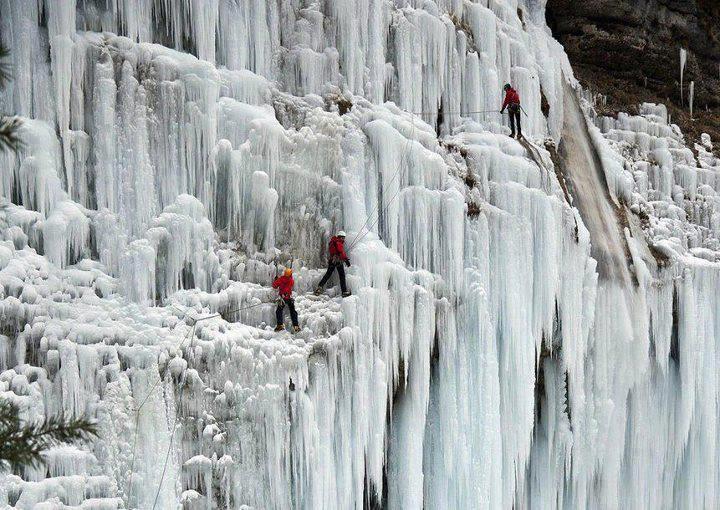
The power of edges is of course the energy generated there.  The transformation of an edge is the awareness we are there and the courage not to turn away.

Like most things of importance, meeting and transforming an edge takes practice.  We have to come up to it and turn away umpteen times, priming an inner awareness of it.  Breaking that cycle (because it occurs so frequently with a particular edge) is an exercise of patience for an inner life.  Knowing I ultimately have to bring other aspects of myself to the edge besides the one that gets me there is useful.

So, I start out doing an “impossible” task, one I’ve never done, have no familiarity or seeming aptitude for and hence feel supremely uncomfortable in the approach.  It’s a task I have never attempted out of decades of deep seated fear and layers of complex beliefs.  But, my mind knows it has to be done, there is no not doing it.  My body is sort of curious about this new never-been-done-before quest and is somewhat willing because it is supported by the determined mind.  The emotional center of myself is fully crazed about the prospect, has dug in her heels and can be heard whining about it almost constantly, nay-saying and dooms-daying as we start to move through the steps of the task.  Normally, all the ruckus the emotions create would stop the rest of me in my tracks.  But the methodical mind is on a roll.  And wisely, she hasn’t taken her usual imperious stance, dominating the rest of me.  She takes a wise-parent approach and this makes all the difference.  She keeps moving forward doing the laid out steps (with the help of the able and curious body), while cajoling the emotional part.  “We’re just going to do this for three hours today, it might be sort of fun. We’ll make no determinations, we’re just trying an experiment.”  

photo credit: Sterni
The three hours experience could be likened to dragging a full cart with no wheels.  It is like a flailing child on my left hip, causing me to do a sort of Igor/Frankenstein walk, dragging this besides-herself-little-one clinging, kicking and screaming.  There is a general feeling of supreme discomfort, even pain.  Confusion sets in in increments and I have an impression of being on the deck of a boat on a rolling ocean. Something in me knows the confusions and overwhelm are part and parcel of the effort and not to spend too much time trying to unravel them. Parts of myself are internally cowering, pretending they are stupid and don’t know anything.  This “I don’t know anything!” drama I find is actually helpful; my past indoctrination says, when you are a rank novice at something, mistakes are allowed, mercy is shown, the boom doesn’t get lowered.  Wow! It’s ok not to know. 

The three hours are up, I pack ‘us’ into the car.  There is a visceral sensation I am all in pieces, kind of shredded, and the main impression I have of myself.  I do a lot of inner cooing and reassuring on the way home, actually talking aloud:  “Ok. THATS over.  We’re done for the day, on our way home now.  We did great! We’ll have some nice tea when we get there and take the rest of the day off.  We won’t think or do anything else about this for now.”  Something in me is dutiful to this; faintly tempted to consider doing some thinking work on the process, she just lets it go.  There would be time for this action in awhile when most of me was feeling more settled, less shredded.

photo credit:  Barbara Corvine
There are a lot of edges in this.  Not only the ‘impossible’ task at the center, but experiencing the emotional dramas of the small child that still lives and her bounty of extreme impressions and reactions.  Also, the benevolent parent who somehow doesn’t marginalize the wailing child, but just keeps moving forward with a type of empathy for the fear-ridden.  That there were beginnings, middles and definite ends in the steps was enormously helpful; it provided lampposts (a short term goal) to get to and complete.  The practice of doing this exercise multiple times was great for the whole, because they all came to know it was survivable.  We would get through this, we did it before.  Each time, a new step became a bit more detailed and “serious”.  Each time newish terrors would surface, the intimidation factor would become more heightened.  And each time the benevolent parent would rise to the occasion, “It’s ok. We can do this.  It is terrifying.  We’re in this together.”

Part of meeting and transforming this edge was not getting bogged down in the smokescreens other parts of the self would create (the usual “turn away” factor).  They were noted, sometimes momentarily overwhelming, but not distracting enough to derail the intention set.  The presence of someone compassionate and benevolent, not willing to annihilate the ruckus-causing parts for her own purposes was also very unifying.  A sense even the disruptive have a place in the process, a voice to be recognized, a value-- significantly diffuses the power of the ensuing polarized anarchy. It was a joint effort, no Lone Ranger in sight.

Possibly, the transformation of an edge is a rite of passage.  There is no doubt it is entering a crucible of sorts; there is a combustible incineration process, pain and suffering is guaranteed.  But the sense of liberation and the infusion of a clear, bright energy once one has stepped through that door is an experience of tasting the magnificence of being Alive.  Once done, the possibility of navigating the course of an edge undeniably exists. It is also gives a perspective that illusions abound and confirms I may be living much of my life behind a veil.


Saturday, August 3, 2013

Dispassionate Empathy

This oxymoronic term resonates curiously with what is (possibly) true.  And the seeming truth of dispassionate empathy is that it is momentary, usually fleeting and almost always misunderstood.  Why is this?  Dispassionate empathy is a delicate (yet powerful) experience that can never be static, contrived or a destiny to be reached.  Like presence or wisdom, it's a movable feast, something we travel in and out of on a momentary basis.  Our human propensity is to make and understand things hard and fast, to have things known, to be static; black and white.  Dispassionate Empathy can not be a given known.  It's an experience in an often 'gray' moment, not be harnessed.

dis·pas·sion·ate  not influenced by strong feeling; especially : not affected by personal or emotional involvement*

Dispassion is a place a lot of caretakers find themselves after having their compassion take one too many trips on the heart-pull roller coaster.  It's a survival place, a space to operate from where one can feel accomplished in their skill efficacy without taking the risk of entering the healing relationship.  It keeps them emotionally safe, fairly free of confusion and armored to the hilt.  Being habitually armored is a slow, numbing soul death, not to be wished on anyone. All caretakers are required to be compassionate, yet struggle to maintain a professional distance to avoid over-involvement.  This is between a rock and a hard-place.  Burnout is a given when sitting between these two stools, or hanging open or closed hearted; it is to be expected when a study and a practice of a therapeutic (double sided) empathy has not been seriously undertaken.

em·pa·thy: 1. the imaginative projection of a subjective state into an object so that the object appears to be infused with it;  2. the action of understanding, being aware of, being sensitive to, and vicariously experiencing the feelings, thoughts, and experience of another of either the past or present without having the feelings, thoughts, and experience fully communicated in an objectively explicit manner*

I almost did not include the first definition of empathy above, as it seems to be counter to the second definition.  But I am curious and appreciate the other side of the coin, as it completes the entirety and ultimately the whole rings more true.  The imagination (being an integral part of the human makeup) is open to coincide with being available to impressions.  In that act, one's knowledge/experience base is recognized and tweaked; one feels a twinge of familiarity.  Having experienced well a feeling scenario one can:  project it onto another (if a healing hasn't been had and self asks to go there again to be healed) or if a healing has been had, one usually feels compelled to merely be with it while witnessing another find their way, somewhat separated and internally active while being externally passive (another intriguing oxymoron!).

This is a practice.  It's also a spiritual quest.  The spirit is infused in the back-and-forth of the dual action/effort of separating and resonating.  Listening, staying close to the response (not the reaction), witnessing the pull and resistance that moves from inside to out and back again.  The practice of dispassionate empathy is allowing light to filter into the quiet of an observation, remembering one's place, applying restraint when necessary and affirmation otherwise.  Mostly, dispassionate empathy is about maintaining one's inner and outer vertical, losing it and reclaiming it again, repeatedly.  It is a practice.  Some moments we are better at it than others.  When it arrives, we hope to celebrate its manifestation.  When our personal tension keeps it at bay, we hope to forgive ourselves.


* m-w.com

Friday, July 19, 2013

Memory and the Body (Part II)

As an umbrella term including all age related cognitive impairments, dementia in industrial and developing countries is epidemic. The number of cases of dementia worldwide in 2010 was estimated at 35.6 million.(1) Rates increase significantly with age, with dementia affecting 5% of the population older than 65 and 20–40% of those older than 85. (2)  While western medicine is trying to figure out the "cure" and management for this condition, it also would be useful to understand and explore the energetics and the relationship of the culture at-large to this malady.

In science terms, what is happening to those experiencing some form of dementia?  This is a neurological disease, meaning that the neurons and the connections in the body that serve them (synapses, transmission factors) are impaired.  This may be due to an accumulation of protein plaques as part of normal aging, atrophy of vessels effecting subtle communications to the brain, inflammation, inadequate blood sugar, and traumatic brain injury.  In energetic terms, it could be said, there is a block or impingement in the flow of qi or prana:  an energetic (and organic) circulation problem.

We are energetic beings living in layers upon layers of an energy charged world. We are influenced by these layers of energy (universal and material) and we concurrently influence the macrocosmos in how we tend and don't tend our own energy fields.  Life force (the condition of our energy fields, qi, prana) is thinnest at both ends of life's spectrum: infancy and old age.  Because of this, these two populations (as well as the ill) are extremely sensitized to energy.  They are practically osmotic in their internal reception to energy.     They are supremely (non-cognitively) aware of surrounding tensions and are impacted profoundly by even mild (negative, tense) stimulation.  In past posts, when I have mentioned the term "a deeper listening capacity", these populations are living there.  Not out of choice (which would be ours if we choose to nourish that in ourselves) but because their energy fields are thin (or "holey"); there is little to no buffer for them. For most of the rest of us, we have the buffers of ego and personality which usually supersede  these delicate places.  The daily dying we do, the moving in and out of sleep and dream states, straddling these (energy?) "other" worlds are transitions those experiencing dementia obliquely traverse.

For the infant and elderly populations, cognition and reason are not available (not developed yet or disease altered).  Hence, an experience of pain does not always register through the brain's pathways, but is nonetheless energetically experienced.  The sensitized "outsider" looking on would recognize its manifestation as irritability, restlessness, uncharacteristic (negative-based) behaviors.  Between 25% and 50% of older adults experience persistent pain. Seniors with dementia experience the same prevalence of conditions likely to cause pain as the elderly without dementia. Pain is often overlooked in older adults and, when screened for, often poorly assessed, especially among those with dementia since they become incapable of informing others that they're in pain. Beyond the issue of humane care, unrelieved pain has functional implications. Persistent pain can lead to decreased ambulation, depressed mood, sleep disturbances, impaired appetite and exacerbation of cognitive impairment, and pain-related interference with activity is a factor contributing to falls in the elderly. (3)

In the dementia literature, it is stated 40-50% of patients with the illness are depressed.  From my observations, depression and anxiety are prevalent as a past history in these patients.  What's first, the 'chicken or the egg' is the question that comes to me.  From a qi perspective, experiences of anxiety and depression are blocks in the flow of emotional health; it is the plaque in our feeling center that prevents joy, gratitude and acceptance.  Whereas there is an organic, physical/mental atrophy present in dementia progression, considering the flow of qi, life force in our emotional lives is also an imperative.

Finally, one of the things not often considered in the global dementia epidemic, is the place of the larger community.  For those in robust health, entertaining the notion we all are dying a little bit each day, navigating the dying process through dream states, minute loss of one function or another, is difficult to entertain.  As was said, we have the ego and personality buffers that are considerably removed from the truth of momentary dying.  But putting ourselves in the experience of one with cognitive deficits, means to enter that supremely sensitized energy state.  It is possible to straddle the cognitively 'clear' world one lives in while being in a rich and interesting relationship with someone who doesn't have those attributes.  It means listening more deeply, becoming more observant to energy manifestations and intrigued by the being that Is.  It means detaching a bit from what I think is Real.  It means setting aside my preconceived ideas as to what is meaningful and the probable emphasis on rational thought.


1.  Alzheimer's Disease International (2009). World Alzheimer Report 2009. p. 38. Retrieved 11 March 2012.
2.  Sadock, Benjamin James Sadock, Virginia Alcott (2008).Kaplan & Sadock's concise textbook of clinical psychiatry (3rd ed.). Philadelphia: Wolters Kluwer/Lippincott Williams & Wilkins. p. 52. ISBN 978-0-7817-8746-8.
3. Hadjistavropoulos, T et al.; Herr, K; Turk, DC; Fine, PG; Dworkin, RH; Helme, R; Jackson, K; Parmelee, PA et al. (2007). "An interdisciplinary expert consensus statement on assessment of pain in older persons". Clinical Journal of Pain 23 (1 suppl): S1–43. doi:10.1097/AJP.0b013e31802be869. PMID 17179836 
Shega, J; Emanuel, L; Vargish, L; Levine, S.K.; Bursch, H; Herr, K; Karp, J.F.; Weiner, D.K. (2007). "Pain in persons with dementia: complex, common, and challenging". Journal of Pain 8(5): 373–8. doi:10.1016/j.jpain.2007.03.003. PMID 17485039.
Blyth, F; Cumming, M.R.; Mitchell, P; Wang, J.J. (2007). "Pain and falls in older people". European Journal of Pain 11 (5): 

Monday, June 24, 2013

Patience

Patience is power.  Patience is not an absence of action; 
\\
\\
rather it is 'timing' it waits on the right time to act, for the right principles and in the right way.” ― Fulton J. Sheen

Whether you are waiting for a toddler to grow up, body tension to let go in a meditation, an ancient one to get to their destination three feet away, a "presenting" other to drop into a part of themselves a little more real or the paradigm to shift significantly in healthcare or the economy, patience (in good measure) is required.  Patience.  That virtue probably hardest to come by.

"Genius is eternal patience". --- Michelangelo 

In the moment of patience, my ego, identity, my natural rhythm is challenged.  Something or someone else comes first besides my wants and even needs.  This is valuable.  There is a suffering, a sacrifice, a payment made.  And this is unusual.  Rarely do I let discomfort in so willingly.  Behind that moment is a true feeling which merits recognition, an attention.

Make your ego porous. Will is of little importance, complaining is nothing, fame is nothing. Openness, patience, receptivity, solitude is everything.” ― Rainer Maria Rilke

\
Energetically, patience is slowwwww.  A consistent, sustained attempt at patience requires a conscious return to my norm.  My normal rhythm, my usual ego self, putting myself first.  This is an important piece of the patience experience.  Otherwise, masochism and a wrong self-sacrifice evolve.  Patience needs to become part of the self-care piece, not the antithesis.  From this perspective, patience becomes fluid.  It is the water on the stone, the river that finds its own way around the rocks and the bank.

“He that can have patience can have what he will.” ― Benjamin Franklin

To be in the state of patience, is to be in the moment.  To have an attention that is taking in the Now.  The slippery irritations, the held breath, the railing mind screaming 'boredom!', as well as the curiosity and interest of what is before me which is so other.  In patience there is an allowance of this co-existence and the fluid experience of moving in and out and back again with no set range.

“A waiting person is a patient person. The word patience means the willingness to stay where we are and live the situation out to the full in the belief that something hidden there will manifest itself to us.” ― Henri J.M. Noun

What Henri Noun says above is not entirely true.  In patience, there is no belief, agenda or gift guaranteed.  There can't be.  Otherwise, we would be hanging on for the payoff and the state of patience would not be Free(ing).  Patience, like attention, is free in its most true form.  It's the moving breath that may or may not loosen the tensions or irritations from the interior channel.  It's a practice to return to, a renewable flow available to engage.

\